Knowledge note
Triton: Tiled GPU Kernel Language and Compiler
The original Triton language and compiler for expressing tiled neural network computations as portable, high-performance GPU kernels — introducing tile-level IR, hierarchical tiling, memory coalescing, and auto-tuning that achieve cuBLAS/cuDNN parity.
Triton: An Intermediate Language and Compiler for Tiled Neural Network Computations
Paper: Triton: An Intermediate Language and Compiler for Tiled Neural Network Computations Authors: Philippe Tillet, H. T. Kung, David Cox (Harvard University / IBM) Venue: MAPL 2019 (3rd ACM SIGPLAN International Workshop on Machine Learning and Programming Languages) Date: June 22, 2019
Related pages: Frameworks Overview, CUDA Programming Model, SGLang, vLLM
TL;DR
What: Triton is a programming language and compiler that lets developers write GPU kernels using high-level tile abstractions — statically shaped multi-dimensional sub-arrays — instead of manually managing CUDA threads and shared memory.
How: Triton introduces a three-layer architecture: Triton-C (a C-like frontend with tile types and broadcasting), Triton-IR (an LLVM-based IR extended with tile-level data-flow and predicated control-flow), and Triton-JIT (a compiler that auto-applies hierarchical tiling, memory coalescing, shared memory allocation, and barrier synchronization).
The number: Triton’s generated matrix multiplication kernels achieve >90% peak device utilization, matching cuBLAS performance and outperforming contemporary DSLs (Tensor Comprehensions, PlaidML, TVM) by 2–3× on recurrent and transformer workloads.
The Big Picture
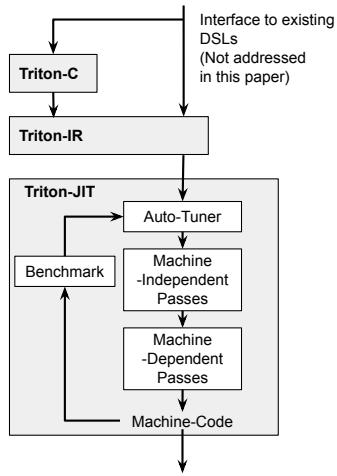
① Triton-C: developer writes a kernel using tile variables (e.g., float C[TM, TN] = 0) with broadcasting and predication. ② Triton-IR: the frontend lowers tile operations into an LLVM-based IR with retiling instructions (reshape, broadcast), element-wise tile ops, and PSSA predication. ③ Triton-JIT: a series of compiler passes — pre-fetching, peephole optimization, hierarchical tiling, memory coalescing, shared memory allocation, and barrier insertion — transform Triton-IR into efficient LLVM bitcode. ④ An auto-tuner sweeps tile size parameters (powers of 2) to find the optimal configuration per problem shape.
Why This Exists
Before Triton, writing a fast GPU kernel for a novel DNN operation meant choosing between two bad options:
-
Vendor library lock-in. cuBLAS and cuDNN are fast but only cover a fixed set of operations (matmul, standard convolutions). If your research introduces a new primitive — say, a shifted convolution or a custom sparsity pattern — you are on your own.
-
DSLs that are too slow. Polyhedral compilers (Tensor Comprehensions) and loop synthesizers (Halide, TVM) could express arbitrary operations but produced kernels 2–3× slower than hand-tuned vendor libraries. You could write a CUDA micro-kernel by hand, but that takes expert-level effort and ties you to a specific GPU architecture.
Concretely, for a transformer matrix multiplication with $A \in \mathbb{R}^{1760 \times 1760}$ and $B \in \mathbb{R}^{N \times 1760}$, existing DSLs hit only 30–60% of the GPU’s roofline, while cuBLAS reaches ~90%. Triton’s key insight is that tiling is the universal primitive: every efficient GPU kernel decomposes work into tiles that fit registers, shared memory, and compute units. By making tiles a first-class language concept and automating the tiling optimization, Triton closes the gap.
The Landscape
flowchart TD
  subgraph "Before Triton"
    cuBLAS["cuBLAS / cuDNN\n(Hand-tuned vendor libs)"] --> |"Fast but fixed API"| Gap["Gap: novel ops\nneed expert CUDA"]
    TC["Tensor Comprehensions\n(Polyhedral model)"] --> |"Flexible but 2-3× slower"| Gap
    TVM["TVM / Halide\n(Loop synthesis + schedules)"] --> |"Flexible, needs\nmanual schedules"| Gap
    PlaidML["PlaidML\n(Tile DSL, no tile-IR backend)"] --> |"High-level tiles\nbut no optimization"| Gap
  end

  Gap --> Triton["Triton (MAPL 2019)\nTile-level IR + auto-optimization"]

  Triton --> |"Language"| TritonC["Triton-C\nCUDA-like + tile types + broadcasting"]
  Triton --> |"Compiler IR"| TritonIR["Triton-IR\nLLVM-IR + tile data-flow + PSSA"]
  Triton --> |"Backend"| TritonJIT["Triton-JIT\nHierarchical tiling + coalescing + shared mem + auto-tune"]

  TritonJIT --> Result["cuBLAS/cuDNN parity\nfor matmul + conv"]
Triton sits at a sweet spot: it provides more flexibility than vendor libraries (any tile-programmable operation), more automation than TVM/Halide (no manual schedule needed), and better performance than polyhedral compilers (tile-level, not loop-level, optimization).
The Core Idea
Every efficient GPU kernel organizes computation into a hierarchy of tiles: large tiles that fit in shared memory, micro-tiles that fit in registers, and nano-tiles that map to individual compute units. The key insight of Triton is that by elevating tiles to first-class language citizens — with their own types, broadcasting rules, and predicated control flow — a compiler can automatically reason about the tiling hierarchy, memory layout, and synchronization without the programmer ever writing a CUDA thread or a __syncthreads() call.
Symbol Map
Triton uses tile shapes as compile-time (or auto-tuned) constants. The notation is positional and explicit.
| Symbol | Human name | Scope | Plain meaning |
|---|---|---|---|
TM, TN |
Tile-M, Tile-N | per-kernel, tunable | Tile size along the M (row) and N (column) dimensions. |
TK |
Tile-K | per-kernel, tunable | Tile size along the reduction (K) dimension. |
float C[TM, TN] |
Accumulator tile | per-thread-block | 2D tile of partial dot-product results, kept in registers. |
get_global_range(axis) |
Global range query | per-kernel-instance | Returns the 1D tile of indices assigned to this kernel instance on the given axis. |
@predicate statement |
Predicated execution | per-element | Guards a tile-level operation: only elements where the predicate is true execute. |
reshape, broadcast |
Retiling instructions | Triton-IR | Reshape changes tile dimensionality (e.g., padding with ones); broadcast replicates along size-1 axes. |
icmpp, psi |
PSSA instructions | Triton-IR | Predicated SSA: icmpp returns true/false predicate tiles; psi merges values from different predicate streams. |
Deep Dive
1. Triton-C: The Programmer’s View
Triton-C looks like CUDA-C but replaces per-thread logic with tile-level operations. A matrix multiplication kernel (Listing 1 in the paper) shows the key differences:
Tile declarations use a dedicated syntax (float C[TM, TN] is a 2D tile, not a C array). Shapes can be tunable — the auto-tuner picks the best values from a constrained set (e.g., {16, 32, 64, 128}).
Broadcasting replicates tiles to match shapes automatically, following NumPy semantics: left-pad with ones, then replicate. For example, a + b where a is int[16] and b is int[32, 16] first reshapes a to [1, 16], then broadcasts to [32, 16].
Predication with @ guards tile operations against out-of-bounds access at tensor edges without branching. This is critical because tiles cannot be partially executed — either the whole tile runs or none of it does.
Built-in intrinsics — dot (tile matrix multiply), trans (transpose), get_global_range (SPMD index query) — map directly to optimized hardware paths.
// Key snippet: the accumulator loop in Triton-C
float C[TM, TN] = 0;
for (int k = K; k >= 0; k -= TK) {
    float A[TM, TK] = check_a ? *pa : 0;   // predicated load
    float B[TN, TK] = check_b ? *pb : 0;
    C += dot(A, trans(B));                   // tile matmul + accumulate
    pa = pa + TK * M;                        // pointer bump
    pb = pb + TK * N;
}
2. SPMD Model: No Threads, No Barriers
Triton’s programming model differs fundamentally from CUDA’s (Figure 3):
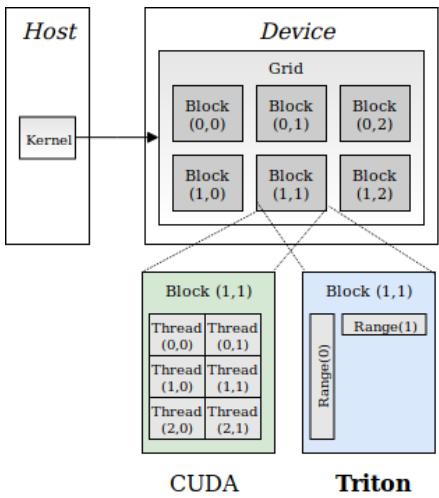
Left: CUDA launches a grid of thread blocks, each containing many threads. The programmer manages thread indexing, shared memory, and __syncthreads(). Right: Triton launches each kernel instance as a single-threaded program associated with global index ranges. Parallelism is inferred automatically from the tile structure.
This SPMD model eliminates three pain points:
- No thread-level indexing. You work with tiles, not individual threads.
- No shared memory management. The compiler allocates and synchronizes shared memory automatically.
- No manual barrier insertion. The Triton-JIT shared memory synchronization pass inserts barriers where needed using data-flow analysis of RAW and WAR hazards.
3. Triton-IR: Tile-Level Data-Flow and Control-Flow
Triton-IR extends LLVM-IR with two categories of tile operations.
Data-Flow: Retiling Instructions
reshapechanges a tile’s dimensionality by padding shapes with ones. A 1D tilei32<8>can becomei32<1, 8>for broadcasting.broadcastreplicates data along size-1 dimensions to match a target shape:broadcast i32<8, 8> %valtakes ai32<1, 8>and copies rows.
Standard scalar instructions (add, mul, load, getelementptr) are extended to work element-wise on tile operands. Specialized intrinsics (dot, trans) handle matrix-level operations.
Control-Flow: Predicated SSA (PSSA)
Tiles cannot branch per-element. Triton solves this with the Predicated SSA form:
icmpp(predicated compare): returns two predicate tiles — one true, one false — for each element position.@predicate: guards an instruction so it only executes where the predicate is true.psi: merges values from different predicate streams, like a per-element?:operator.
This enables edge masking — loading 0 for out-of-bounds elements — without per-element branches.
4. Triton-JIT: Automatic GPU Optimization
The JIT compiler applies passes in a fixed order, each exploiting the tile structure of the IR.
Machine-Independent Passes
- Pre-fetching detects load instructions inside loops and inserts a second load one iteration ahead. This hides memory latency by overlapping loads with computation — critical when arithmetic intensity is low.
- Peephole optimization exploits tile algebra: chains of transposes simplify via $(X^T)^T = X$.
Machine-Dependent Passes
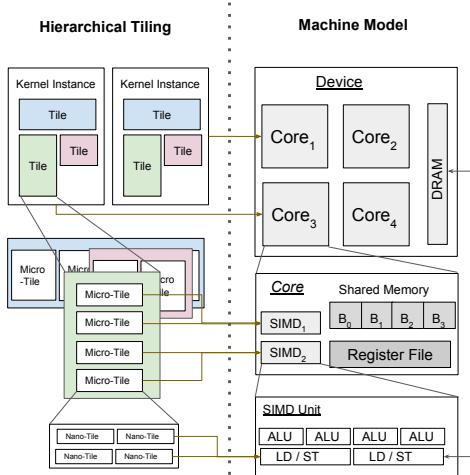
① A large tile is decomposed into micro-tiles that fit in shared memory. ② Micro-tiles are further decomposed into nano-tiles sized for register files and warp-level compute. The auto-tuner sweeps powers of two for each decomposition level.
Hierarchical tiling decomposes each tile into micro-tiles (shared memory sized) and nano-tiles (register/warp sized). Because Triton-IR programs are structured around tiles (not arbitrary loop nests), the compiler can enumerate valid decomposition strategies without polyhedral machinery.
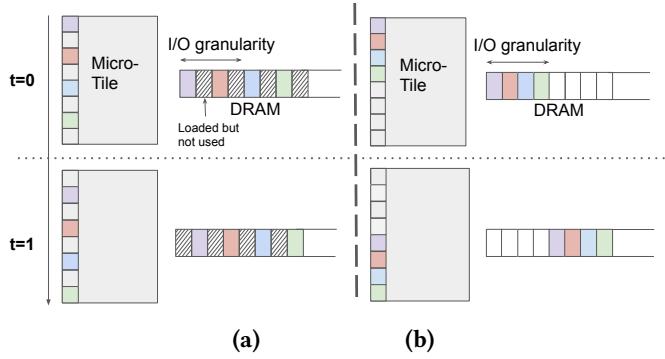
Left: uncoalesced access — threads in different colors access non-adjacent memory, requiring multiple DRAM transactions. Right: coalesced access — the Triton backend reorders threads within each micro-tile so adjacent threads access adjacent memory, minimizing transactions.
Memory coalescing reorders virtual threads within each micro-tile so that adjacent threads access adjacent memory addresses. Since Triton kernels are single-threaded SPMD, the compiler has full freedom to map tile elements to hardware threads in coalescing-friendly layouts.
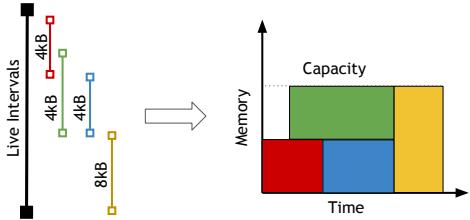
Live ranges of tile variables are analyzed: tiles with overlapping live ranges cannot share the same shared memory space. The compiler uses a linear-time interval allocation algorithm to minimize shared memory footprint while maximizing reuse.
Shared memory allocation analyzes live ranges of tile variables and packs them into shared memory using a linear-time interval allocator. This is analogous to register allocation, but for shared memory — tiles that don’t overlap in time can reuse the same space.
Shared memory synchronization inserts barriers using data-flow analysis. For each program point, the compiler tracks which variables have pending reads and writes in shared memory. When a read-after-write (RAW) or write-after-read (WAR) hazard is detected, a barrier is inserted. The analysis uses forward data-flow equations, treating the set intersection of pending operations as the barrier trigger.
Auto-Tuner
The auto-tuner operates on a small search space: 3 tiling parameters per dimension per tile, each chosen from powers of two (32–128 for tile sizes, 8–32 for micro-tiles, 1–4 for nano-tiles). An exhaustive search over this compact space is practical and effective. The paper notes that only the hierarchical tiling pass was auto-tuned; future work could extend this to other passes.
5. Performance Results
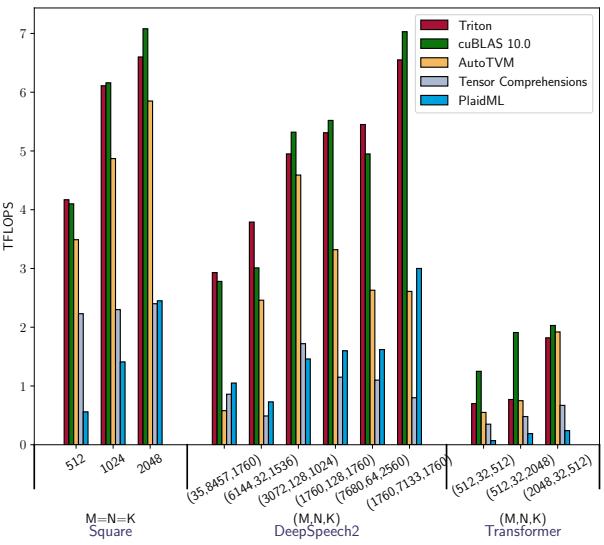
Matrix multiplication throughput across deep learning workloads. Triton matches cuBLAS, achieving >90% peak on favorable shapes. cuBLAS retains a slight edge on very small transformer shapes thanks to a 3D parallel reduction algorithm. DSLs (TC, PlaidML, TVM) lag by 2–3× on most shapes.
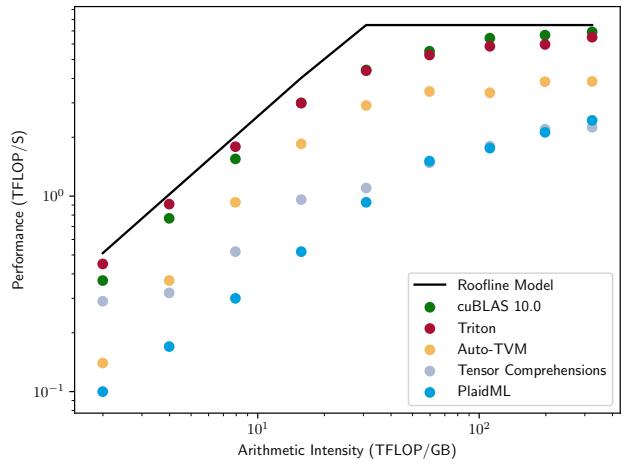
Roofline analysis for $C = AB^T$ with $A \in \mathbb{R}^{1760 \times 1760}$. As the K dimension (and thus arithmetic intensity) increases, Triton approaches the device’s compute bound. DSLs flatline well below the roofline due to poor tile-level optimization.
Key results:
- Matrix multiplication: Triton matches cuBLAS across recurrent (DeepSpeech2) and transformer shapes, reaching >90% peak device utilization. On very small transformer shapes, cuBLAS leads slightly via a 3D parallel reduction algorithm that Triton could adopt later.
- Dense convolution: Triton’s reimplementation of cuDNN’s
IMPLICIT_GEMMmatches or exceeds cuDNN on ResNet convolutional layers. The authors speculate cuDNN underinvests in 3×3 IMPLICIT_GEMM because Winograd is faster for that case. - Shifted convolution: A fused shift-conv kernel in Triton (Listing 8) almost entirely hides the shift overhead, achieving near-identical performance to a plain 1×1 convolution — enabling novel CNN architectures that were previously impractical without custom CUDA.
What Triton Enabled
Triton (the language described in this paper) was the seed for what became OpenAI’s Triton, now widely used for writing high-performance GPU kernels in PyTorch. The core ideas — tile-level abstraction, automatic memory hierarchy management, and SPMD without manual thread management — remain the foundation of modern Triton.
Limitations and Future Work (as of 2019)
- No tensor core support. The paper explicitly leaves this for future work; modern Triton has since added it.
- Auto-tuning scope. Only the hierarchical tiling pass was auto-tuned; other passes (pre-fetch depth, shared memory allocation strategy) used fixed heuristics.
- Integration gap. Triton at this stage was a standalone compiler; integration into higher-level frameworks (PyTorch, JAX) came later.
- SPMD model restrictions. The single-threaded SPMD model means Triton cannot express algorithms that require cross-thread communication patterns beyond what the tiling passes can infer.