Knowledge note
Scatter/Gather
A pipeline-boundary optimization that sends different activation shards across slow links, then reconstructs the full tensor on the destination side with fast local collectives.
Scatter/Gather
Scatter/Gather is a pipeline-boundary communication optimization that reduces redundant cross-node activation transfers by sending different shards across the slow link and reconstructing the full tensor on the destination side.
Why It Exists
The generic primitives behind this optimization are the same ones described in the Medium article: scatter sends different shards to different ranks, while gather or all-gather reconstructs the larger tensor later. In a pipeline-parallel setup with tensor parallelism, that decomposition matters because inter-node links are slower than intra-node links. Without scatter/gather, the same full activation can cross the slow link once per tensor-parallel rank.
How It Works
-
Scatter (sender side): The activation tensor is split into $t$ equal chunks. Each tensor-parallel rank sends only one chunk over the inter-node link to the corresponding rank in the next pipeline stage.
-
Gather (receiver side): The receiving ranks reconstruct the tensor locally. In Megatron-LM this is commonly an intra-node all-gather over the faster link inside the node.
This reduces the cross-node payload from $b \cdot s \cdot h$ (full tensor, $t$ redundant copies) to $\frac{b \cdot s \cdot h}{t}$ (one shard per rank).
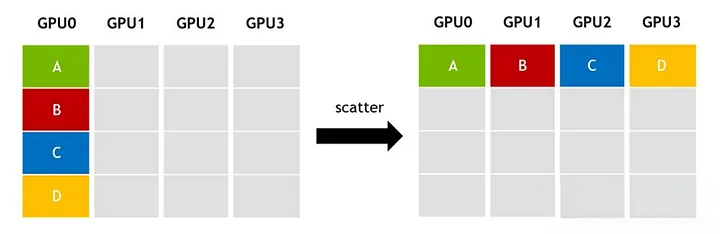
Source: In-Depth Understanding of AI Distributed Training Communication Primitives. The article’s scatter figure shows the sender-side half of the optimization: different shards go to different GPUs instead of broadcasting the same full tensor to all of them.
Impact
Megatron-LM reports up to 11% throughput improvement for communication-intensive schedules (large batch sizes with interleaved 1F1B). The optimization is especially important for the interleaved schedule, which increases pipeline communication frequency — without scatter/gather, the redundant cross-node traffic would cancel out the interleaving benefit.
Where It Appears
- Megatron-LM: GPU-Cluster Training Parallelism — Introduced as part of the PTD-P training system; Section 5.7 shows the 11% throughput gain on GPT-3 175B.
- The technique is accelerator-agnostic and applies to any distributed training system where intra-node bandwidth (NVLink) vastly exceeds inter-node bandwidth (InfiniBand).
Related Terms
- All-Gather — The NCCL collective that reconstructs the full tensor on the receiving side of scatter/gather.
- Microbatch — Smaller microbatches increase communication frequency, making scatter/gather more important.