Knowledge note
TileLang Design and Code Learning Path
A repository-backed guide to TileLang's Python tile DSL, TIRX elaboration, backend-owned compiler pipelines, JIT specialization, and runtime adapters.
TileLang Design and Code Learning Path
Repository: tile-ai/tilelang
Inspected revision: 5a9b2a54b9a04831886d9b4dfd7a9ad758cd7ebd
(main, v0.1.13-40-g5a9b2a54, inspected 2026-08-10)
Evidence boundary: clean checkout, static source reading only. This ingest did
not compile or run a kernel, inspect generated device code, validate numerical
correctness, or measure performance on CUDA, ROCm, Metal, or CPU hardware.
Related pages: Frameworks, Triton: Tiled GPU Kernel Language and Compiler, Triton in Practice, and General Matrix Multiply (GEMM).
TL;DR
What: TileLang is a Python-embedded domain-specific language (DSL) for writing kernels in terms of tiles, explicit memory scopes, structured loops, and operations such as copy and matrix multiplication.
How: Python first elaborates into TVM TIRX that still contains TileLang operations. A selected backend owns the pass sequence that plans software pipelines, infers layouts, lowers tile operations to target instructions, generates device code, and chooses the host execution adapter.
One thing to remember: TileLang’s main abstraction boundary is not “Python versus C++.” It is target-neutral tile intent versus target-specific lowering. Most of the design makes that boundary explicit and extensible.
The Mental Model
Think of TileLang as five connected layers:
| Layer | What the user writes or the system owns | Design purpose |
|---|---|---|
| Tile program | T.Kernel, scoped buffers, T.Pipelined, T.copy, T.gemm |
State the computation and useful scheduling intent without spelling every instruction. |
| TIRX construction | Eager builder or returned PrimFunc |
Convert Python structure into analyzable compiler IR while retaining shapes, scopes, source spans, and tile operations. |
| Backend context | Target, pass pipeline, device/host code generators, execution policy | Resolve one coherent backend configuration for a compilation. |
| Lowering pipeline | Layout inference, software pipelining, tile-op lowering, synchronization, host/device splitting | Turn intent into legal target-level loops, memory accesses, and instructions. |
| JIT adapter | TVM FFI, Cython, NVRTC, PyTorch/Metal, or CuTe DSL | Compile/load the artifact, bind tensor arguments, launch it, and expose a Python callable. |
The repository’s original overview captures this progressive lowering from a tile program to a tile library, thread primitives, source code, and finally a hardware-specific executable:
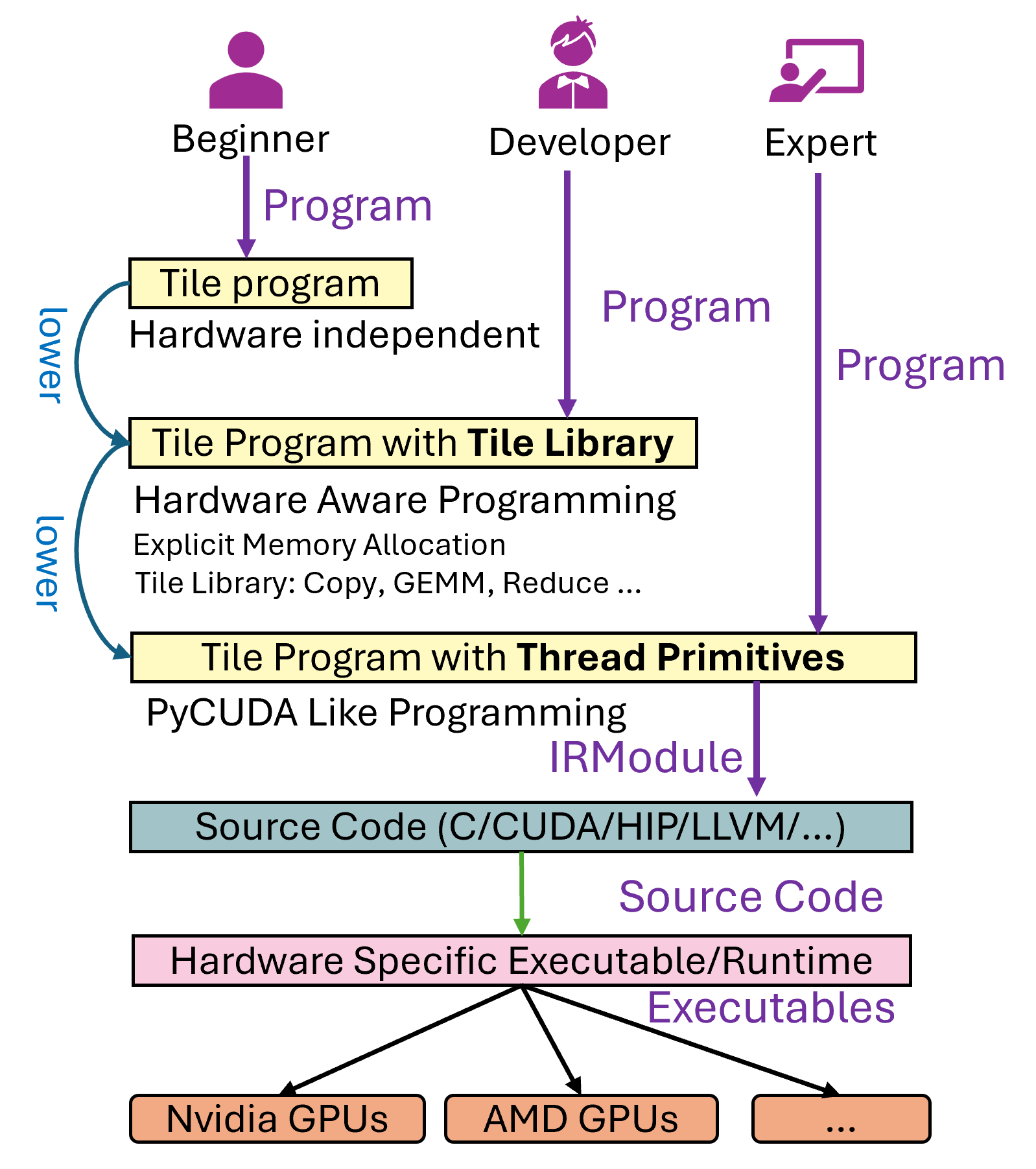
Source figure copied from
docs/_static/img/overview.png
at the inspected revision.

Start from the Programming Model
The fastest way into the codebase is the
examples/quickstart.py::matmul
example. It contains nearly the whole language model in miniature:
- Tensor annotations describe global inputs and output shape.
T.Kerneldeclares the grid and thread-block launch.T.alloc_sharedstages input tiles in block-visible memory.T.alloc_fragmentholds per-thread accumulator fragments.T.Pipelinedexpresses overlap across K tiles.T.copymoves data between scopes.T.gemmpreserves a tile-level matrix operation for later lowering.T.Parallelmaps the ReLU epilogue over the result tile.
This programming model is explicit about the costly state transitions—off-chip to on-chip memory, fragment accumulation, and the final store—while delegating instruction selection and many synchronization details to the compiler. That is the central productivity/performance tradeoff.
What changes state, and when?
| Time | State transition |
|---|---|
| Python decoration | The function is wrapped with its signature, source, and compile options; no device kernel has run. |
| First specialized call | Runtime tensor metadata and compile-time arguments form a cache key; Python elaborates a specialized TIRX function. |
| Compiler lowering | Abstract scopes and tile operations become physical layouts, loops, synchronization, target intrinsics, and separate host/device modules. |
| Artifact creation | Generated source and optionally a device binary/runtime module are attached to a CompiledArtifact. |
| Invocation | An adapter binds tensors and launches the compiled kernel. Later calls with the same specialization reuse the cached kernel. |
End-to-End Compilation and Execution Flow
1. @tilelang.jit captures the Python function
The public
jit()
decorator records compile options, rewrites the function through prim_func
with eager-JIT support, captures its source and signature, and returns a
JITImpl. TileLang supports two authoring styles:
- Eager: tensor arguments are passed to the decorated function; the builder elaborates and executes the specialized kernel on demand.
- Lazy: the Python function constructs and returns a
PrimFunc; the caller receives a compiled kernel object and invokes it separately.
The distinction changes how TIRX is obtained, but both styles converge on the same compiler and adapter stack.
2. The first call specializes; later calls reuse
JITImpl.__call__()
infers eager versus lazy mode, binds arguments, derives a two-phase cache key,
compiles on a miss, and then either executes immediately or returns the kernel.
This is where shape/compile-time specialization enters the design: generated
code can assume the chosen shape and tile parameters, while another call shape
gets a distinct kernel.
This also explains an important failure mode: the “first call” can be slow because it includes Python elaboration, compiler passes, device compilation, and adapter construction. Steady-state timing must exclude that cold path.
3. Python elaborates into TIRX
For eager code,
JITFunc._build_tir_template()
creates a builder, runs the transformed Python body inside a prim_func frame,
and returns a reusable TIR template. The builder also carries source-span logic,
which lets later compiler errors point back to Python locations instead of only
showing transformed IR.
The launch itself remains target neutral. The
T.Kernel()
surface emits thread-binding loops; the backend later materializes them. This is
why one high-level program can reach GPU and CPU pipelines even though their
physical execution models differ.
4. Tile operations remain semantic calls
T.copy and T.gemm do not immediately emit CUDA or HIP instructions:
T.copy()normalizes source/destination regions and emitstl.tileop.copywith hints such as coalescing, TMA preference, and loop layout.T.gemm()emitstl.tileop.gemmwith operand regions, transpose flags, warp policy, accumulator semantics, and target-relevant annotations.
Keeping these operations semantic until layouts and target capabilities are known is what lets the compiler choose among SIMT copies, asynchronous copies, Tensor Memory Accelerator (TMA), MMA/WGMMA/TCGEN5 paths, ROCm MFMA/WMMA, Metal matrix operations, or scalar/CPU fallbacks.
5. One backend context binds all target decisions
The immutable
BackendModule
is the backend extension contract. A backend declares:
- target kinds it owns;
- one lowering pipeline and device code generator per target kind;
- allowed execution adapters;
- optional host code generators, hooks, capability predicates, and callbacks.
create_backend_context()
normalizes the target, chooses a host target, finds exactly one matching backend,
and resolves an available execution policy. Passing this frozen context through
lowering avoids one stage silently selecting a different target or adapter than
another.
At this revision, the project’s documented main paths include CUDA, HIP, Metal,
experimental LLVM CPU, CuTe DSL, and WebGPU; external ecosystem adapters cover
other accelerators. The exact support levels and architecture qualifications
are recorded in the pinned
Platform and Backend Support
table. “Backend exists” should not be read as equal feature or performance
parity: architecture-specific operations still require compatible hardware.
6. Common orchestration delegates to the backend
lower_to_host_device_ir()
wraps a PrimFunc as a module, extracts parameter metadata, performs
backend-independent semantic checks, calls the chosen backend pipeline, and
filters the result into host and device modules.
That division is deliberate:
- common orchestration defines invariants shared by every target;
- the backend controls transformations whose order and legality depend on its memory and instruction model;
- the execution adapter controls how compiled artifacts meet Python tensors.
7. CUDA shows why pass order is part of the design
The CUDA backend is the deepest representative path. Its high-level
CUDAPassPipelineBodyPrologue()
orders transformations so each prepares invariants for the next:
- bind the target and materialize the kernel launch;
- normalize indices, verify parallel loops, and simplify;
- optionally form producer/consumer warp specialization;
- plan and inject software pipelining;
- infer fragment/shared-memory layouts;
- lower tile operations only after those layouts exist;
- legalize access, vectorization, and safety details.
The C++
LowerTileOpPass::VisitStmt_(EvaluateNode)
then recognizes semantic tile calls, gathers the current target, thread bounds,
layout and buffer maps, supplies workspace/barrier callbacks, and asks the
selected operator implementation to lower itself.
The later
CUDAPassPipelineBody()
handles physical allocation placement, barriers, buffer flattening,
vectorization, storage rewriting, thread synchronization, host/device split,
shared-memory merging, fence insertion, packed API generation, and launch
lowering.
This ordering teaches an important compiler lesson: layout inference, instruction selection, buffer versioning, and synchronization are coupled. A new pass cannot be placed merely where its input type compiles; it must run where its assumptions are true and before later passes erase the information it needs.
8. Code generation produces an artifact; adapters make it callable
_lower_with_context_impl()
runs inside a Z3 analyzer context, obtains host/device IR, invokes device codegen,
inspects the generated kernel source, and packages the modules, parameters,
source, targets, and optional runtime module as a CompiledArtifact.
For CUDA, the registered
BACKEND
connects the CUDA pass pipeline, device code generators, execution policies,
host generators, source validation, and compilation callback. Its compilation
callback also uses a binary cache keyed by code, architecture, format, and
compiler options.
Finally,
JITKernel._compile_and_create_adapter()
runs lowering inside the TVM pass context and selects the concrete adapter:
TVM FFI, Cython, NVRTC, Metal/PyTorch, or CuTe DSL. The JITKernel exposes that
adapter’s callable as its Python execution surface.
Why the Design Works
It preserves optimization freedom
Tile operations retain more semantic information than already-expanded thread loops. The backend can decide layout and instruction family using shape, dtype, memory scope, target architecture, and neighboring operations together.
It separates stable concepts from volatile hardware
T.Kernel, T.copy, T.gemm, and scoped buffers are comparatively stable.
Hopper TMA/WGMMA, Blackwell TMEM/TCGEN5, AMD MFMA, Metal cooperative tensors,
and CPU vectorization evolve independently behind backend manifests and passes.
It makes extension seams explicit
A new backend is not just a code generator. It must provide a coherent bundle:
target matching, pass pipeline, device codegen, supported execution policy, and
possibly host hooks and callbacks. BackendModule validates that bundle early.
It treats compilation as a cached runtime service
Tile parameters and tensor metadata specialize the program; the JIT and binary caches amortize compilation. This is productive for dynamic Python frameworks, but cold-start cost and cache-key correctness become part of system behavior.
Where Platforms Diverge
| Concern | Shared contract | Typical divergence |
|---|---|---|
| Launch | Target-neutral kernel frame | SIMT block/thread launch, Metal dispatch, or CPU loop materialization |
| Memory | Global/shared/fragment intent | Scope legality, layout/swizzle rules, alignment, and available on-chip memories |
| Copy | tl.tileop.copy regions and hints |
Synchronous loops, CUDA cp.async/TMA, backend-specific async mechanisms |
| Matrix compute | tl.tileop.gemm |
CUDA MMA/WGMMA/TCGEN5, AMD MFMA/WMMA, Metal matrix ops, CPU lowering |
| Pipeline | Structured producer/consumer intent | Barrier types, stage limits, warp specialization, and fallback behavior |
| Runtime | JITKernel adapter contract |
TVM FFI, Cython, NVRTC, PyTorch/Metal, or CuTe DSL dependencies |
Do not assume a high-level primitive guarantees the same instruction on every target. Explicit architecture-specific APIs often fail when unavailable; generic operations may select a legal fallback. Inspect generated source and profile the actual hardware path.
Failure Surfaces to Learn Early
| Symptom | Likely boundary | What to inspect |
|---|---|---|
| Python annotation or builder error | Elaboration | Eager/lazy mode, tensor versus compile-time arguments, source span |
| Semantic-check failure | Common lowering | Shape, dtype, memory-scope, or launch invariant |
| Wrong or missing hardware instruction | Layout/tile-op lowering | Target architecture, inferred layout, operand scopes, fallback rules |
| Race or incorrect result | Pipeline/synchronization | Buffer versioning, producer-consumer dependency, barriers, edge predicates |
| Slow first call | JIT and device compile | Specialization count, source/binary cache behavior, adapter construction |
| Slow steady state | Generated kernel | Memory movement, occupancy, register/shared-memory use, instruction choice |
| Adapter/load error | Host-runtime boundary | Compiler availability, runtime libraries, FFI/DLPack, include paths, binary compatibility |
A Practical Learning Path
Stage 1: Learn the surface by changing one GEMM
- Read the linked quickstart GEMM above end to end.
- Change
block_M,block_N,block_K, threads, and pipeline stages. - Predict the change in global-memory traffic, on-chip capacity, parallelism, and accumulator pressure before measuring.
- Inspect
get_kernel_source()and verify which path was actually generated.
Achievement: you can explain why matrix tiling reduces repeated global-memory traffic and why a larger tile may still lose through occupancy or register pressure.
Stage 2: Trace Python into IR
Read in this order:
- The JIT package — decorator, mode, and specialization cache.
- The eager language builder — builder and TIR template.
- The language kernel module — launch frame.
- The allocation, copy, GEMM, and loop modules — language calls and annotations.
Achievement: you can identify what is evaluated in ordinary Python and what is represented in TIRX for the compiler.
Stage 3: Trace one tile operation through CUDA
- Start at
T.gemmorT.copy. - Find the emitted
tl.tileop.*call. - Follow
LayoutInferenceandLowerTileOpin the linked CUDA pipeline. - Enter the linked C++ tile-op lowering pass and the target-specific operator implementation.
- Continue through device codegen and compare generated source for two GPU architectures.
Achievement: you can say which choice is authored, inferred, target-selected, or inserted for correctness.
Stage 4: Understand the extension contract
Compare the CUDA, ROCm, Metal, and CPU backend declarations against
BackendModule. Note which components are common and which target owns.
Achievement: you can sketch the minimum coherent backend and know why copying a device code generator alone is insufficient.
Stage 5: Validate behavior, not just structure
The remaining work must happen on suitable hardware:
- compile the same kernel for at least two targets or architectures;
- inspect intermediate IR before/after layout and tile-op lowering;
- verify numerical results against a framework reference;
- separate cold compile latency from warm kernel latency;
- profile memory throughput, compute utilization, occupancy, registers, shared memory, and synchronization stalls;
- test non-divisible shapes and unsupported-instruction fallbacks.
This page supplies the static map. Only those experiments can confirm the runtime and performance claims for your environment.
Extension Map
| Goal | Start here | Follow next |
|---|---|---|
| Add a user-facing primitive | Language package | Operator registration, C++ lowering, backend-specific implementations, tests |
| Add a compiler optimization | Target pass-pipeline module | Required IR invariants, placement relative to layout/pipeline/sync passes, transform tests |
| Add a backend | Backend module contract | Existing smallest backend, pass pipeline, codegen, execution policy, host hooks |
| Add a runtime adapter | JIT adapter package | Adapter selection, caching, tensor binding, packaging tests |
| Debug wrong code | lower trace/pass diff tools | Source spans, IR before/after suspect pass, generated source, target-specific tests |
| Tune performance | examples and autotuner | Tile sizes, pipeline depth, layouts, resource usage, architecture-specific kernels |
What Is Established and What Is Not
Established by pinned source reading: the DSL-to-TIRX boundary, eager/lazy specialization path, backend manifest contract, common lowering orchestration, CUDA pass ordering, tile-op dispatch, artifact construction, and adapter selection described above.
Not established here: that every documented backend is equally complete; that a specific operation selects a particular instruction for arbitrary shapes; that synchronization is correct for a modified kernel; that generated code is numerically correct; or that TileLang matches a vendor library’s performance. Those claims require compilation, tests, generated-code inspection, and hardware profiling.