Knowledge note
MiMo-V2.6-Flash-MOPD: vLLM Inference and Deployment
Flash-specific vLLM launch profiles, MXFP4 support requirements, AMD backend caveats, and optional DFlash configuration for Xiaomi's MiMo-V2.6-Flash-MOPD.
MiMo-V2.6-Flash-MOPD: vLLM Inference and Deployment
Model: XiaomiMiMo/MiMo-V2.6-Flash-MOPD
vLLM recipe: MiMo-V2.6-Flash-RL on vLLM — this family recipe selects MOPD by default and its launch command targets that checkpoint.
Related pages: MiMo-V2.6-Pro-MOPD deployment, vLLM, vLLM data-parallel deployment, Mixture of Experts, and KV Cache.
The Xiaomi model card and vLLM recipe were captured on 2026-10-10; the recipe reports an update on 2026-10-07. These are source-backed deployment profiles, not a local GPU test. No checkpoint was loaded or benchmarked for this page.
TL;DR
What: Flash-MOPD is the MOPD2-distilled 309B-total / 15B-active Flash checkpoint, and Xiaomi targets it at reducing repeated tool calls.
How: The vLLM recipe uses vLLM 0.31.0+, an H200 TP4 reference launch, MiMo
reasoning/tool parsers, and the vllm generation config.
The deployment constraint: The recipe estimates 173 GB of MXFP4 checkpoint weights and at least 208 GB of aggregate VRAM; the 1M-token context is a maximum, not a promise of 1M-token concurrency.
Why the MOPD Variant
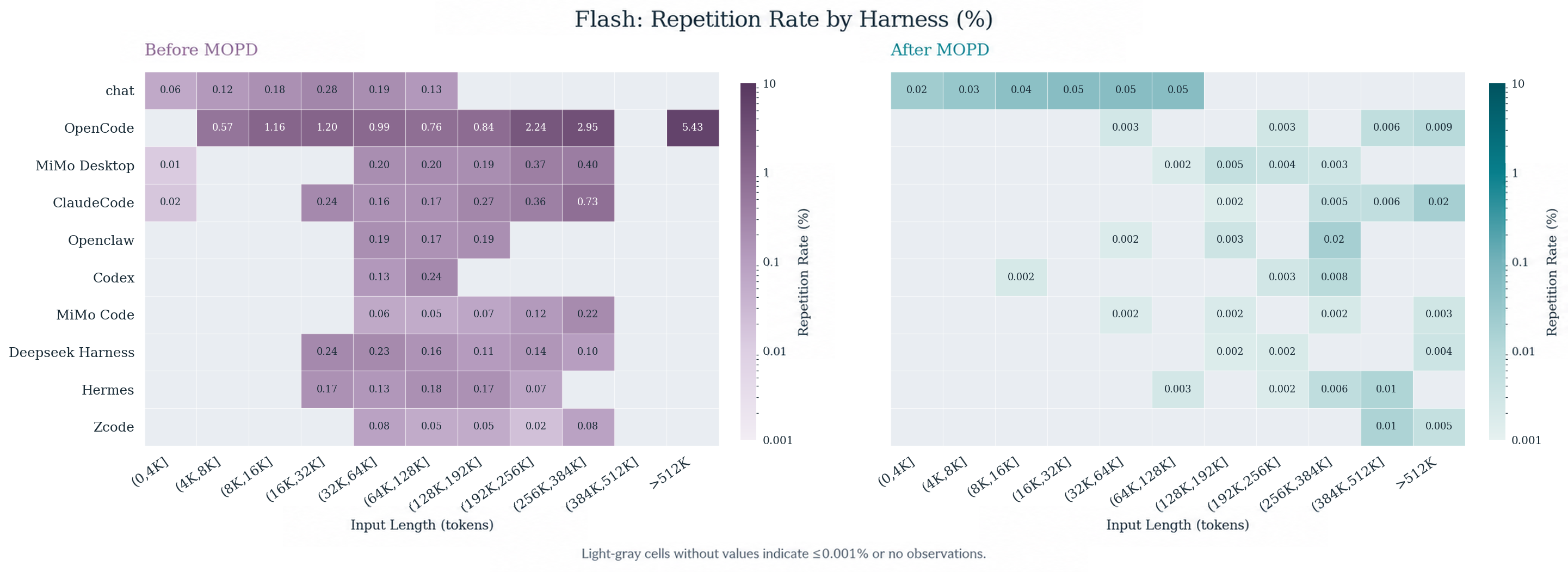
Source: Xiaomi’s Flash-MOPD model card. The chart compares the Flash RL-stage checkpoint with Flash-MOPD across agent harnesses and input lengths. Displayed values are lower after MOPD; light-gray cells mean “≤0.001% or no observations,” not confirmed zero repetition.

The model card calls Flash-MOPD an upgrade to Flash-RL, and the vLLM recipe recommends MOPD for new deployments. The recipe also notes that tool-call repetition was more pronounced in the Flash line than in the Pro line. This behavior motivates the checkpoint choice; it does not change the inference flags.
Model Shape and Memory
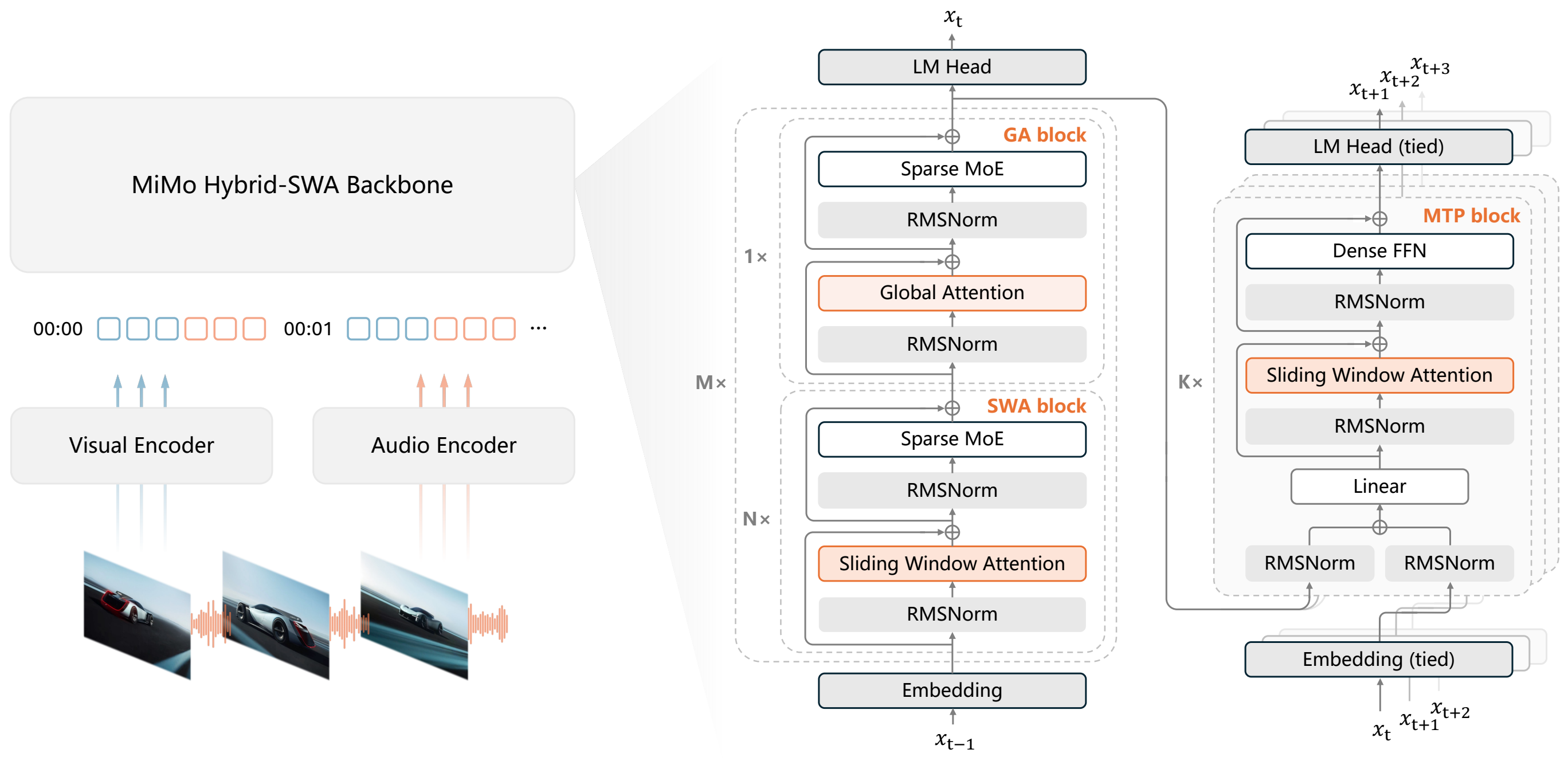
Source: Xiaomi’s Flash-MOPD model card. ① Vision and audio encoders feed the multimodal backbone. ② The 48-layer backbone combines sliding-window and global attention with sparse experts. ③ The model includes an MTP drafter; enabling DFlash in vLLM requires a separate speculative config.

| Serving property | Flash-MOPD configuration | Operational meaning |
|---|---|---|
| Sparse core | 309B total / 15B active parameters; 48 layers, 256 routed experts, top-8 | Active compute is not the amount of checkpoint weight memory that must be resident. |
| Layer recipe | 1 dense layer plus 47 MoE layers; 39 sliding-window and 9 global-attention layers; window 128 | The checkpoint is hybrid attention, not a dense-only Transformer. |
| Context and inputs | Up to 1,048,576 tokens; text, image, video, and audio | Keep the recipe’s --max-model-len auto as the starting point and test each required modality. |
| Weight and compute format | MXFP4-stored weights; FP8 block-wise e4m3 compute (128 × 128); 173 GB checkpoint | Use a vLLM build with MiMo V2 MXFP4/BF16-router support. |
| Draft model | Five-layer DFlash-style MTP drafter; predicts up to seven tokens per pass | The checkpoint includes a drafter, but the explicit DFlash launch adds --speculative-config. |
There is a count discrepancy in the captured Hub page: its model summary and the vLLM recipe say 309B, while the generated Hub metadata widget says 311B. The sources do not reconcile the counts. For deployment sizing, use the recipe’s 173 GB checkpoint estimate and 208 GB aggregate-VRAM floor rather than inferring memory from either parameter count.
The advertised context limit also increases KV-cache pressure as prompts and generations grow. The reference command does not force the full 1,048,576-token maximum.
vLLM Version and Hardware
The vLLM recipe says vLLM 0.31.0 is the first stable release that loads MXFP4-stored weights; earlier stable releases cannot. Its NVIDIA container reference is:
docker pull vllm/vllm-openai:v0.31.0
The model card’s generic pip install vllm snippet is not version-pinned and
points to the V2.5-era vllm/vllm-openai:mimov25-cu129 image. The newer vLLM
recipe says that image predates MXFP4 support, so use v0.31.0 or a later
validated build instead.
| Platform | Recipe reference | Notes |
|---|---|---|
| NVIDIA H200 | 4 GPUs, TP4 | Stable vLLM 0.31.0; command below. |
| AMD MI355X (gfx950) | 4 GPUs, TP4; the recipe also says TP2 works | Use the ROCm settings below; the recipe’s reference command selects TP4. |
| AMD MI300X / MI325X (gfx942) | The prerequisites list 4 GPUs, TP4; the dedicated optimized launch uses TP2 | Requires a nightly build after 2026-09-30 and the AITER Triton MXFP4 backend; the v0.31.0 stable path falls back to emulation. |
| Other hardware | At least 208 GB aggregate VRAM, per the recipe | Capacity alone does not guarantee supported kernels or equivalent performance. |
The recipe title also names GB300 NVL4, but this captured page’s explicit launch blocks cover H200 and AMD configurations. Do not infer a GB300 parallelism shape from the title alone.
H200 TP4 Reference Launch
This is the vLLM recipe’s single-node H200 configuration for Flash-MOPD:
vllm serve XiaomiMiMo/MiMo-V2.6-Flash-MOPD \
  --tensor-parallel-size 4 \
  --trust-remote-code \
  --gpu-memory-utilization 0.95 \
  --max-model-len auto \
  --reasoning-parser mimo \
  --tool-call-parser mimo \
  --enable-auto-tool-choice \
  --generation-config vllm
| Setting | Purpose |
|---|---|
--tensor-parallel-size 4 |
Matches the recipe’s single-node H200 baseline. Do not copy the Pro-MOPD TP8 setting into this Flash configuration. |
--trust-remote-code |
Enables the checkpoint’s custom model code. Pin and review the model revision when reproducibility or code provenance matters. |
--gpu-memory-utilization 0.95 |
Uses the recipe’s 95% vLLM memory target; reduce it for shared GPUs and re-check load and KV-cache capacity. |
--max-model-len auto |
Preserves the reference setting rather than forcing the full advertised context. |
--reasoning-parser mimo |
Selects the MiMo reasoning parser. |
--tool-call-parser mimo --enable-auto-tool-choice |
Enables MiMo tool-call parsing and automatic tool selection for tool-using clients. |
--generation-config vllm |
Uses the generation-config mode selected by the model-specific recipe. |
The official H200 command does not add a generic --dtype or quantization
override. Keep MXFP4 loading tied to a supported vLLM build.
OpenAI-Compatible Smoke Test
The recipe demonstrates the OpenAI chat-completions endpoint:
curl -X POST http://localhost:8000/v1/chat/completions \
  -H "Content-Type: application/json" \
  -d '{
    "model": "XiaomiMiMo/MiMo-V2.6-Flash-MOPD",
    "messages": [{"role": "user", "content": "Hello MiMo!"}],
    "temperature": 1.0,
    "top_p": 0.95,
    "chat_template_kwargs": {"enable_thinking": true}
  }'
The recipe recommends temperature=1.0 and top_p=0.95. Set
"enable_thinking": false or omit the template keyword to disable thinking.
The example is text-only; it does not validate image, video, or audio requests.
AMD MI355X TP4
The MI355X configuration from the vLLM recipe is:
VLLM_ROCM_USE_AITER=1 \
VLLM_ROCM_QUICK_REDUCE_QUANTIZATION=INT4 \
vllm serve XiaomiMiMo/MiMo-V2.6-Flash-MOPD \
  --tensor-parallel-size 4 \
  --trust-remote-code \
  --kv-cache-dtype fp8 \
  --max-model-len auto \
  --reasoning-parser mimo \
  --tool-call-parser mimo \
  --enable-auto-tool-choice \
  --generation-config vllm
This is a ROCm-specific command, not a variant of the NVIDIA container launch. The recipe says MI355X can also run TP2; keep TP4 as the documented baseline unless the available memory and workload have been checked.
AMD MI300X / MI325X (gfx942)
For gfx942, the recipe gives a separate AITER path. Its launch command uses TP2:
VLLM_ROCM_USE_AITER=1 \
VLLM_ROCM_QUICK_REDUCE_QUANTIZATION=INT4 \
vllm serve XiaomiMiMo/MiMo-V2.6-Flash-MOPD \
  --tensor-parallel-size 2 \
  --trust-remote-code \
  --max-model-len auto \
  --reasoning-parser mimo \
  --tool-call-parser mimo \
  --enable-auto-tool-choice \
  --moe-backend aiter_triton_mxfp4_bf16 \
  --generation-config vllm
This backend flag requires a vLLM nightly built after 2026-09-30 and AITER 0.1.20 or newer; it is not in the v0.31.0 stable branch. The recipe says the default gfx942 emulation path is correct but has about 6.5× lower output throughput, and cites end-to-end verification on MI300X. Treat these as the recipe’s reported results, not measurements from this workspace.
Optional DFlash Speculative Decoding
The checkpoint ships a DFlash drafter, but vLLM needs its local dflash/
directory as the speculative model path. Download the checkpoint first, then
set DFLASH_DIR to that directory in the resolved local snapshot:
DFLASH_DIR=/absolute/path/to/local-snapshot/dflash

vllm serve XiaomiMiMo/MiMo-V2.6-Flash-MOPD \
  --tensor-parallel-size 4 \
  --trust-remote-code \
  --gpu-memory-utilization 0.95 \
  --max-model-len auto \
  --speculative-config "{\"method\":\"dflash\",\"model\":\"${DFLASH_DIR}\",\"num_speculative_tokens\":7}" \
  --compilation-config '{"cudagraph_mode":"FULL_DECODE_ONLY"}' \
  --reasoning-parser mimo \
  --tool-call-parser mimo \
  --enable-auto-tool-choice \
  --generation-config vllm
Do not pass a Hub repository ID or a textual <repo>/dflash subfolder as the
draft model path; the recipe says it needs a concrete local path. The drafter
inherits the target TP size by default. Add "draft_tensor_parallel_size": 4
only when pinning or disambiguating that topology.
Deployment Checks
| Failure condition | Why it matters | Response |
|---|---|---|
Stable vLLM older than 0.31.0 or the mimov25-cu129 image |
These predate the recipe’s MXFP4-stored-weight support. | Use vLLM 0.31.0 or a later build validated against MiMo-V2.6. |
| MI300X/MI325X gfx942 on the v0.31.0 stable path | The recipe reports a correct but much slower emulation fallback; the optimized backend needs a later nightly. | Use the documented nightly/AITER backend or benchmark the fallback knowingly. |
| Forcing the full 1M context without checking cache capacity | Long requests consume more KV cache and can reduce concurrency or fail to fit. | Start with auto; measure production prompt lengths and concurrency before setting an explicit cap. |
DFlash points to a Hub ID instead of a local dflash/ directory |
vLLM does not resolve that Hub subfolder as the draft model. | Download the checkpoint and set the concrete local directory path. |
| Treating a text-only response as multimodal validation | The source lists image, video, and audio support, but the smoke test sends text only. | Exercise each required modality and the production chat template before rollout. |
Remember: Flash-MOPD is smaller than the Pro-MOPD sibling but still a 309B-total MXFP4 checkpoint. Use the Flash-specific TP4 baseline, pin a compatible vLLM build, and treat DFlash and AMD gfx942 as explicit backend choices rather than assuming the base launch enables them.
Go Deeper
- Model card: XiaomiMiMo/MiMo-V2.6-Flash-MOPD
- vLLM deployment recipe: MiMo-V2.6-Flash-RL on vLLM — MOPD is the default variant in the captured recipe.
- Compare the Pro checkpoint: MiMo-V2.6-Pro-MOPD deployment
- Scale-out: vLLM Data-Parallel Deployment
- Memory background: KV Cache and Mixture of Experts