Knowledge note
vLLM Block Table Management: From PagedAttention to the V1 KV Cache Stack
A code-backed deep dive into how vLLM's V1 block pool, per-group KV cache managers, hash-based prefix caching, and worker-side block table build and manage the logical-to-physical mapping that PagedAttention kernels consume.
vLLM Block Table Management: From PagedAttention to the V1 KV Cache Stack
Repository: vllm-project/vllm
Inspected commit: dd11df04f3b7046c40f13e586ac38a3725bc3c03
Checkout state: clean, static reading on 2026-08-03
Paper: Efficient Memory Management for LLM Serving with PagedAttention (SOSP 2023)
Related pages: vLLM: PagedAttention Serving Framework, vLLM Continuous Batching, Mamba2 and Linear-Attention Prefix-Cache Path, KV Cache, PagedAttention, Block Table
TL;DR
What: vLLM’s block table is the per-request logical-to-physical mapping that lets a growing KV cache live in fixed-size non-contiguous memory pages, exactly like an OS page table.
How: A shared BlockPool hands out physical blocks with reference counts; per-attention-type managers build each request’s logical block list, share blocks by touching refcounts, reuse cached prefixes by chained hashes, and hand the worker a compact int32 block-table tensor that PagedAttention kernels index.
The number: The paper reports prior systems store usable KV state in as little as 20.4% of their KV memory; vLLM’s paged design bounds a request’s waste to at most one block, turning the rest into larger batch sizes.
The Big Picture
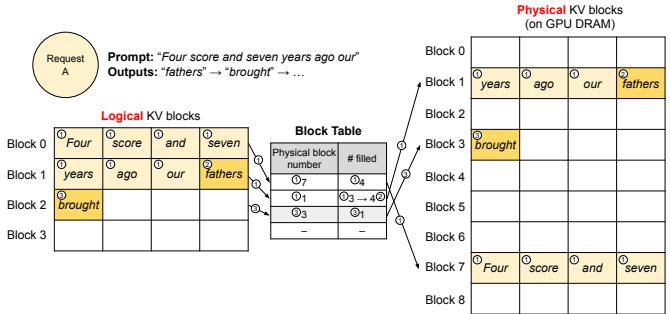
Original PagedAttention paper Figure 6, preserved locally. ① A 7-token prompt fills logical blocks 0 and 1, mapped to physical blocks 7 and 1 — the first block holds 4 tokens, the second 3 with 1 free slot, tracked by the #filled column. ② First decode step writes the new KV into the free slot of physical block 1. ③ Second decode step finds block 1 full, so the manager allocates physical block 3, records it in the table, and the kernel reads all three blocks.
Why This Exists
Naive serving systems reserve one contiguous chunk of KV memory per request sized for the request’s maximum possible sequence length. That single decision creates three kinds of waste at once:

Original PagedAttention paper Figure 3, preserved locally. Each box is a request’s pre-reserved chunk; the red slots are memory that can never serve tokens.
| Waste type | Cause | When it is known |
|---|---|---|
| Reserved slots | Space held for future generated tokens | Only realized as waste when a request finishes short |
| Internal fragmentation | Over-provisioning for a max length that never happens | Only realized after sampling |
| External fragmentation | Buddy-allocator gaps between variable-size chunks | Known before serving, never usable |
A single OPT-13B token needs about 800 KB of KV cache, so one request can demand up to 1.6 GB. When most of that is pre-reserved and idle, far fewer requests fit, and GPU utilization collapses. The paper’s own profiled numbers show prior systems store usable KV state in only 20.4% to 38.2% of their KV memory.
The fix is to stop reserving for the future and allocate block-by-block as tokens actually arrive — the same reason operating systems page, not pre-allocate, process address spaces.
The Landscape
flowchart LR
    OSVM["OS virtual memory / paging"] --> PAGED["PagedAttention paper (SOSP 2023)"]
    PAGED --> V0["vLLM V0 KV cache manager (vllm/core/block)"]
    V0 --> V1["vLLM V1 block stack (vllm/v1/core)"]
    ORCA["Orca iteration-level scheduling"] --> VLLM["vLLM serving engine"]
    VLLM --> V1
    SGLANG["SGLang RadixAttention"] -. "sibling: richer radix-tree reuse" .-> PREFIX["Hash-based prefix caching (APC)"]
    PREFIX --> V1
    SWA["Sliding window attention"] --> RECYCLE["Block recycling (remove_skipped_blocks)"]
    RECYCLE --> V1
    MAMBA["Mamba / linear-attention state cache"] --> RECYCLE
    DCP["Decode context parallelism"] --> COORD["Multi-group KV cache coordinator"]
    COORD --> V1
Landscape synthesis (editable source: landscape.mmd). OS paging is the parent idea; PagedAttention makes it concrete for KV cache; vLLM’s V0 manager evolved into the V1 vllm/v1/core stack, which also absorbs hash-based prefix caching, block recycling for sparse attention, and multi-group coordination for hybrid models. SGLang’s RadixAttention is a sibling approach to the same reuse problem.
The Core Idea
A KV cache block is a fixed-size page; a block table is that page table. The scheduler and the KV cache manager never think about GPU memory addresses — they think about logical block numbers per request. The physical placement is a pool-wide decision that only needs the invariant “one logical block maps to exactly one physical block,” plus a reference count that tells the pool how many requests currently depend on each physical block. Everything else — prefix reuse, copy-on-write, eviction, hybrid-model coordination — is bookkeeping layered on top of those two facts.
Symbol Map
The code has its own compact vocabulary. All symbols below are exact names from the source.
| Symbol | Human name | Scope | Plain meaning |
|---|---|---|---|
block_size |
KV block size | per KV cache group | Tokens per block (default 16); DCP multiplies it for attention groups |
hash_block_size |
hash granularity | global | Tokens per hash unit; GCD of all group block sizes, each group’s block size is a multiple of it |
scheduler_block_size |
scheduling granularity | global | LCM of all group block sizes; hits are reported on this boundary |
KVCacheBlock |
physical block | pool-wide | block_id, ref_cnt, optional _block_hash, free-list links, is_null |
ref_cnt |
reference count | per block | Number of requests sharing this physical block |
req_to_blocks |
logical block table | per request per group | The ordered list of KVCacheBlocks a request owns |
block_hashes |
chained prefix hashes | per request | One hash per hash_block_size unit; each hash fingerprints its whole prefix |
num_cached_block |
cache frontier | per request | How many leading blocks are already registered in the prefix cache |
null_block |
padding block | pool-wide | Block 0, is_null=True, never cached or freed; pads skipped positions |
KV cache group |
cache type | per model | One group per distinct attention type (full, SWA, mamba, cross-attention, …) |
Deep Dive
1. The physical block pool
What it does: Owns every physical KV block and the free-list that decides eviction order.
Why it matters: The pool is the single source of truth for “is there memory?” — the scheduler’s admission decision is just required_blocks <= free_blocks.
How it works: BlockPool starts by materializing num_gpu_blocks KVCacheBlocks and linking them into a doubly linked free queue. Block 0 is peeled off as the permanent null_block. Allocation pops blocks from the head of the free queue; freeing appends them back; a cached block that gets reallocated is first evicted from the prefix-cache hash map. The free queue itself is a hand-rolled doubly linked list that stores its links inside each block, giving O(1) middle removal without allocating Python objects.
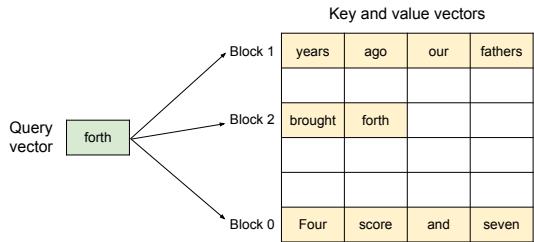
Original PagedAttention paper Figure 5, preserved locally: the key/value vectors for “Four score and seven years ago our…” live in three blocks that are not contiguous in physical memory, and the PagedAttention kernel multiplies the query against each block’s keys separately.
| Operation | Effect | Eviction-order consequence |
|---|---|---|
get_new_blocks(n) |
Pop n from free-list head, ref_cnt += 1 |
Newest reuse is cheapest |
free_blocks(ordered) |
ref_cnt -= 1; at 0, hashed blocks append to tail, unhashed blocks prepend to head |
Unhashed blocks (never usable for APC) get recycled first |
touch(blocks) |
Remove from free-list if present, ref_cnt += 1 |
A prefix hit “rescues” an eviction candidate |
_maybe_evict_cached_block(b) |
Drop its hash from the prefix map on reallocation | Cache entries never block allocation |
The intuition: The free-list is an LRU with a twist — never-cacheable blocks jump the queue, and tail-of-chain blocks (more hash tokens) evict before head blocks.
A concrete example: Reusing the paper’s Figure 6 walkthrough: the pool holds blocks 0..N; block 0 is the null block; when the second decode step needs a third logical block, get_new_blocks(1) hands back physical block 3 from the free-list head, and ref_cnt on block 3 becomes 1.
Remember: Allocation is a queue pop; freeing is an ordered queue push; the ordering is the eviction policy.
2. The logical block table per request
What it does: Tracks, for each request and each KV cache group, the ordered list of physical blocks its tokens live in.
Why it matters: This ordered list is the block table — it is what gets serialized to the worker and turned into the kernel’s block-table tensor.
How it works: The coordinator keeps req_to_blocks[request_id] per group. KVCacheManager.allocate_slots() is the entry point the scheduler calls: it counts how many blocks num_tokens needs, checks the free pool, then asks each group manager to append new blocks. Blocks are appended in token order, so the list is always sorted by token position; skipped positions are padded with null_block so index i still means “the block containing token i * block_size”.
The intuition: A request’s block table is an append-only array — the worker relies on this so same-step block IDs never change.
A concrete example: The 7-token prompt gets req_to_blocks = [phys7, phys1]; after the second decode step it becomes [phys7, phys1, phys3] — the new block is appended, never inserted.
Remember: Logical order is preserved by appending; null blocks preserve index arithmetic even when physical blocks are freed.
3. Reference counts and copy-on-write
What it does: Decides when a physical block can be freed (ref_cnt == 0) and lets many requests share one block safely.
Why it matters: Sharing the prompt prefix across parallel samples or a common system prompt is where PagedAttention’s biggest memory savings come from (up to 55% for beam search in the paper).
How it works: touch() increments ref_cnt when a request adopts a cached block; free_blocks() decrements it. Two requests sharing a block both hold a reference, so the block survives until both are done. When one writer needs to diverge from a shared block, the manager allocates a fresh block and queues a KVCacheBlockCopy(src, dst) for the worker to copy the KV data before the writer overwrites. The _apply_cow() path records the redirect and retains both copy endpoints until the worker completes the copy.
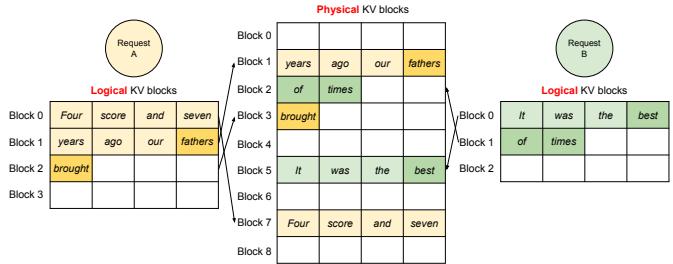
Original PagedAttention paper Figure 7, preserved locally: two sequences (blue and orange) occupy the same physical pool; their neighboring logical blocks are not physically contiguous, and freed blocks are reusable by either sequence.
The intuition: ref_cnt is the garbage collector for the pool — a block lives exactly as long as the last request that points to it.
A concrete example: If a second request arrives whose prompt is the same 7 tokens as the first, its first two logical blocks are physical 7 and 1, and both requests bump those blocks’ ref_cnt to 2. When the first request finishes, its free only drops the count back to 1 — the second request keeps the data alive.
Remember: Sharing is free; divergence costs one copy per diverging block, not a whole-prefix copy.
4. Hash-based prefix caching
What it does: Lets a new request skip computing KV for a prompt prefix that another request already cached.
Why it matters: Chat system prompts, few-shot examples, and repeated agents share huge prefixes; recomputing them wastes the entire prefill.
How it works: Each request’s tokens are hashed in hash_block_size chunks with a chained hash — hash_block_tokens(hash_fn, parent_hash, tokens, extra_keys) — so the hash at boundary $t$ uniquely fingerprints the whole prefix up to $t$. Full blocks register hash + group_id → block in BlockHashToBlockMap. On a new request, FullAttentionManager.find_longest_cache_hit walks the request’s hashes left to right and adopts every matching cached block via touch(). Blocks past the hit are allocated fresh, and only the new suffix is computed.
The prefix-cache index deliberately does not de-duplicate: two requests with identical full blocks get two physical blocks, because block-table IDs must stay append-only (see NOTE in BlockHashToBlockMap).
The intuition: Chaining makes “does my prefix exist?” a single hash lookup per block; sharing is just touch().
A concrete example: The second request from section 3 does not need its 7 prompt tokens recomputed at all — find_longest_cache_hit returns physical blocks 7 and 1, num_new_computed_tokens = 7, and only the first generated token is computed.
Remember: A block is only cached when it is full; the last partial block is never a cache entry.
5. Multi-group coordination for hybrid models
What it does: Keeps one consistent cache-hit length across every KV cache group (full attention, sliding window, mamba state, cross-attention) at once.
Why it matters: Hybrid models (e.g. full-attention + mamba layers, or DeepSeek-style MLA + sparse) have different block sizes per group; the shortest agreeing hit across groups is the only safe one to reuse.
How it works: HybridKVCacheCoordinator.find_longest_cache_hit runs a fixed-point loop: it proposes a hit length, each spec group (SpecGroup) either accepts it or reduces it, and the loop restarts until the length stops shrinking. Full attention is downward-closed (checked once, then only trimmed). Groups with different block sizes reuse the chained hashes at their own granularity via BlockHashListWithBlockSize — the last hash_block_size hash inside a larger block is that block’s hash.
The intuition: The coordinator is a consensus protocol over block sizes — everyone must agree on where the shared prefix ends.
A concrete example: A model with 16-token full-attention blocks and 64-token mamba state blocks: if full attention cached 32 tokens but the mamba group only cached 16, the reconciled hit is 16 tokens — the mamba state at 32 tokens does not exist yet.
Remember: The cache hit is only as long as the weakest group’s cached prefix.
6. Block recycling for sliding-window and mamba models
What it does: Frees blocks that attention will never read again, instead of holding them until the request ends.
Why it matters: Sliding-window attention only reads the last window tokens, and mamba only needs the last recurrent state — holding everything would waste most of the pool.
How it works: Each manager specializes get_num_skipped_tokens(), while remove_skipped_blocks() applies the result: SWA frees everything before num_computed - window + 1, chunked-local frees whole chunks before the current one, mamba frees every state except the last, and R-SWA frees the gap between prefill tail and decode window. Freed positions are replaced by null_block in req_to_blocks so the block table stays index-stable for the kernels.
The intuition: “Skipped” tokens are a memory statement, not just an attention statement — if the window will never look back, the blocks can go.
A concrete example: A request with a 4000-token prompt and a 2048-token sliding window has, after the window moves, roughly 1952 tokens’ worth of blocks freed and padded with nulls — the request’s peak KV is bounded by the window, not the prompt.
Remember: Recycling keeps peak per-request KV at $O(\text{window} + \text{prefix})$, which is what lets long-context and streaming workloads fit at all.
7. Worker-side block table materialization
What it does: Turns the scheduler’s per-request block-ID lists into the actual GPU tensor that attention kernels index.
Why it matters: The kernel does not know about managers or hashes — it only reads block_table[row][col] to find a KV block.
How it works: The scheduler packs each request’s block_ids (per group) into MultiGroupBlockTable. Each group’s BlockTable keeps an int32 CPU+GPU buffer; add_row() writes a request’s block IDs, compute_slot_mapping() fills the per-token slot_mapping tensor (token → physical slot) via a Triton kernel, and commit_block_table() copies to GPU. When the allocation block size differs from the kernel block size, map_to_kernel_blocks() expands each KV block into blocks_per_kv_block kernel blocks.
The intuition: The block table is the only contract between the Python-side memory manager and the CUDA/Triton-side attention — small, dense, and append-only.
A concrete example: The 7-token request’s row is [7, 1] and later [7, 1, 3]; the slot-mapping kernel maps token positions 0-15 to physical block 7, 16-31 to block 1, and so on.
Remember: slot_mapping + block_table are the two tensors that make paged attention read arbitrary physical blocks in constant time.
8. slot_mapping: token → physical slot
What it does: Flattens the per-request block table into a per-token int64 mapping, slot_mapping[t] = block_number * block_size + offset, telling the kernel exactly which physical cache slot holds token t’s KV.
Why it matters: The attention kernel does not read the block table row-by-row — it receives one flat tensor of slots and writes or reads each token’s KV by that index. This is the step that turns “logical token position” into a concrete slot index the paged-cache ops can consume.
How it works: Each BlockTable pre-allocates a 1-D CpuGpuBuffer of slot_mapping (torch.int64, shape [max_num_batched_tokens], pinned CPU + GPU + numpy view) next to its 2-D int32 block_table. _prepare_inputs() calls compute_slot_mapping(), which launches the Triton _compute_slot_mapping_kernel with query_start_loc, positions, and the block table; the kernel writes block_number * block_size + slot_offset per token and stores PAD_SLOT_ID (-1) for padding and for tokens that live on another context-parallel rank.
| Step | Input | Operation | Output |
|---|---|---|---|
| 1. Allocate | max_num_batched_tokens |
one int64 CPU(pinned)+GPU buffer per KV group | slot_mapping buffer |
| 2. Materialize | per-request block IDs | add_row() fills the int32 block table |
block_table.gpu |
| 3. Map | query_start_loc, positions, block_table.gpu |
Triton kernel, one program per request | slot_mapping[t] = block * block_size + offset |
| 4. Pad | num_tokens_unpadded .. num_tokens_padded |
fill with -1 |
CUDA-graph-safe slots |
The runner then re-packages the same buffer in _get_slot_mappings() into two shapes for two consumers: slot_mappings_by_gid (one per KV-cache group) feeds _build_attention_metadata(), and slot_mappings_by_layer (one per layer name) is passed through set_forward_context so each model layer sees its group’s mapping. Encoder-only groups get zeros; the tail beyond num_tokens_unpadded is filled with -1.
The intuition: The block table answers “which blocks does this request own?”; slot_mapping answers “which slot does this token write to?” — it is the block table pre-expanded per token so the kernel never has to do that arithmetic itself.
A concrete example: With block_size = 16 and the 7-token request owning physical blocks [7, 1], the kernel writes slot_mapping[0] = 7*16 + 0 = 112 through slot_mapping[15] = 127, then slot_mapping[16] = 1*16 + 0 = 16 for the token at position 16. Each later decode token lands in the next free slot of block 1, then block 3 — so the kernel stores every new token’s KV at exactly the slot the block table says to.
Remember: block_table is [req, block] int32; slot_mapping is [token] int64 with -1 padding — one maps requests to blocks, the other maps tokens to slots.
Putting It Together
Watch two requests share the pool across one scheduler loop at dd11df04f3b7:
- Pool boot: the engine sizes
num_gpu_blocksfrom GPU memory and the page size (get_num_blocks), andBlockPoollinks them into the free queue. - Request A (the 7-token prompt) is admitted:
allocate_slots()finds 2 blocks free, pops physical 7 and 1, appends them to A’sreq_to_blocks, andcache_full_blocks()registers their hashes after prefill. - Decode steps: each generated token lands in a free slot; when block 1 fills,
get_new_blocks(1)pops physical 3 and appends it. The worker’sMultiGroupBlockTablerow grows to[7, 1, 3]and the PagedAttention kernel reads exactly those blocks. - Request B arrives with the same prompt:
find_longest_cache_hit()returns blocks 7 and 1;touch()bumps bothref_cnts to 2, B skips prefill entirely, and only its first generated token is computed. - A finishes:
free_blocks(A)decrements both shared blocks toref_cnt == 1(B keeps them alive) and frees A’s private tail block, which goes to the LRU end of the free queue. - Memory pressure: if a new request needs a block and the free queue is empty, allocation pops the LRU candidate — a cached-but-unreferenced block — and
_maybe_evict_cached_block()drops its hash so the prefix cache cannot hand it out again.
What This Buys You
The headline claim
Paging the KV cache converts previously wasted memory into larger effective batch sizes, which is the dominant throughput lever for serving.
How we know: paper benchmarks
| Workload | Reported gain |
|---|---|
| OPT-13B, ShareGPT + Alpaca | 2-4× throughput vs. FasterTransformer and Orca |
| Long-sequence & shared-prefix cases | Largest relative gains |
| Beam search memory sharing | Up to 55% of KV memory saved |
The mechanism behind the numbers
Higher effective batch size is the direct consequence of the three waste classes in “Why This Exists” disappearing: no reservation, no internal fragmentation beyond one block, no external fragmentation. More requests in flight means weights are amortized over more tokens per step — exactly the regime where decode, a memory-bound operation, becomes compute-efficient.
⚠️ How to read these numbers
These are 2023 single-GPU OPT-13B benchmarks. Do not treat “2-4×” as a universal multiplier for modern models, multi-GPU deployments, or FP8 caches. The qualitative claim — paging beats contiguous reservation — is what generalizes, not the specific ratios. Also, prefix-cache hit rates in these benchmarks depend heavily on the workload’s prompt overlap; a dataset with unique prompts gets far less benefit from sections 4-5.
Where It Breaks
| Failure mode | When it happens | Impact |
|---|---|---|
| Prefix-cache thrash | Prompts share no prefix; or cache blocks get evicted between identical requests | Hash bookkeeping overhead with zero reuse; occasionally worse than no caching |
| Small block size hurts kernels | block_size too small (e.g. 1) |
More block-table indirection and branch overhead; the paper’s ablation shows block size trades parallelism vs. fragmentation |
| Large block size fragments | block_size too large for short requests |
Internal fragmentation up to one full block per request |
| Refcount drift in CoW | A shared tail block is copied but the copy is never committed by a connector/worker step | Stale KV reads or double frees (the code pins copy endpoints precisely to avoid this) |
| Chained-hash recompute cost | Extremely long prompts with dense hashing | Hash computation adds prefill overhead; mitigations include prefix_match_unit and sparse retention intervals |
| SWA/Mamba recycling + prefix caching interplay | Long sliding-window prompts under memory pressure | A deeper cached prefix may be evicted while a shorter one survives, so hit lengths must be reconciled per group |
One Thing to Remember
A block table is a page table for KV cache: one fixed-size physical block per logical block, an append-only per-request mapping, and a reference count that makes sharing free — and the entire V1 stack in vllm/v1/core exists to keep that mapping consistent across prefix reuse, copy-on-write, hybrid attention groups, and the worker kernels that finally read it.
Go Deeper
- Read: PagedAttention paper (arXiv:2309.06180); the MinerU extraction with all figures is at derived/pdf-markdown/frameworks/serving/vllm/vllm-pagedattention-serving-framework.md.
- Build on: vLLM Continuous Batching for the scheduler loop that calls
allocate_slots; SGLang for the RadixAttention sibling approach; DeepSeek-V2 MLA for a cache-shrinking alternative. - Understand the context: KV Cache, PagedAttention, Block Table, Continuous Batching.
- Trace recurrent prefix reuse: vLLM Mamba2 and Linear-Attention Prefix-Cache Path follows one state checkpoint from hash publication through a consumer’s suffix-only recurrence.
- Reproduce: the whole block stack is in
vllm/v1/core/— start atKVCacheManager.allocate_slots, thenBlockPool, thenMultiGroupBlockTableinvllm/v1/worker/block_table.py.