Knowledge note
All-to-All
A many-to-many collective that scatters each rank's data to all ranks while simultaneously gathering data from all ranks, effectively performing a distributed matrix transpose.
All-to-All
All-to-All is a many-to-many collective communication primitive in which each rank scatters a distinct shard to every other rank while simultaneously gathering a distinct shard from every other rank, effectively performing a distributed data transpose.
Why It Exists
When model parallelism distributes tensors across ranks along one dimension, subsequent operations may need those tensors redistributed along a different dimension. Without all-to-all, such redistribution would require multiple scatter or gather steps stitched together. All-to-all performs this redistribution in a single collective, amortizing latency and bandwidth overhead into one coordinated exchange.
As the Medium source describes it, all-to-all is an extension of all-gather: in all-gather every rank receives the same complete tensor, while in all-to-all every rank receives a different slice. This distinction makes all-to-all the natural collective for transposition workloads.
How It Works
For $r$ ranks, each starting with an $r \times s$ tensor, all-to-all proceeds as:
- Each rank $i$ partitions its data into $r$ shards, each of size $s$.
- Rank $i$ sends shard $j$ to rank $j$, for all $j$.
- After the collective, rank $i$ holds the concatenation of shard $i$ from every rank — a tensor with $r \times s$ total size, but now logically transposed.
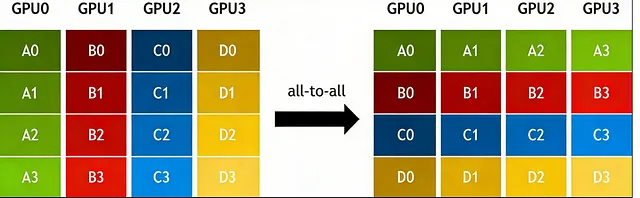
Source: In-Depth Understanding of AI Distributed Training Communication Primitives. The diagram visualizes all-to-all as a transpose: each GPU sends different data to each peer and receives different data from each peer.
In NCCL, all-to-all is implemented as a collective primitive alongside the other common patterns, using topology-aware algorithms to minimize cross-node traffic on the specific interconnect.
Common Confusions
- All-to-all vs. all-gather: All-gather replicates one concatenated result everywhere; all-to-all gives each rank a different concatenated result. All-gather is a duplication; all-to-all is a transpose.
- All-to-all vs. scatter: Scatter is one-to-many from a single root; all-to-all is many-to-many where every rank is both a scatter source and a gather destination.
- All-to-all vs. point-to-point send/recv: A full all-to-all pattern can be built from $r(r-1)$ pairwise messages, but the collective primitive fuses those exchanges into one optimized operation with lower latency.
Where It Appears
- vLLM-Ascend Architecture: How the Ascend NPU Port Integrates with vLLM — A code-reading tour of how vllm-ascend maps onto vLLM’s six-layer stack and extends upstream vLLM for Ascend NPU execution.
- DeepSeek-V4 Inference on Ascend: The DSA Serving Stack in vllm-ascend — How vllm-ascend runs DeepSeek-V4 end to end on Ascend NPUs: model override with mHC hyper-connections, hybrid c4/c128 compressor.
- vLLM-Ascend Kimi K3 MoE Forward Insight — Fresh code-reading insight for how the latest vllm-ascend routed-MoE substrate would execute a Kimi K3-style forward pass.
- Context Parallelism for Scalable Million-Token Inference — Uses All-to-All to return pass-Q partial attention outputs to their source ranks before merging.
-
vLLM DCP and PCP: Decode and Prefill Context Parallelism — The optional DCP A2A backend exchanges partial attention output and LSE in one payload.
- vLLM DCP Attention: From Local LSE to Exact Global Output — Packs output and LSE payloads into an optional all-to-all exact-reduction path.
Related Terms
- All-Gather — The replication counterpart; all-to-all is its transposition-based extension.
- Reduce-Scatter — The reverse of all-gather; reduces data first, then scatters different shards.
- All-Reduce — Reduces data element-wise across ranks instead of rearranging slices.