Knowledge note
All-Reduce
A many-to-many collective that reduces equally shaped tensors across ranks and delivers the identical reduced result to every rank.
All-Reduce
All-Reduce is a many-to-many collective communication primitive that applies the same reduction operation to equally shaped tensors across ranks and returns the identical reduced tensor to every rank.
Why It Exists
Distributed training constantly needs to merge partial work from many accelerators. When each data-parallel replica computes a gradient, those gradients must be combined before the optimizer step. When tensor parallelism splits a matrix multiply, the partial outputs must be aggregated before the next layer can proceed. All-reduce exists because both situations require the same result on every participating rank.
The Medium article frames all-reduce as either reduce + broadcast or reduce-scatter + all-gather. That decomposition is useful operationally: if the next step only needs a shard of the reduced tensor, reduce-scatter may be cheaper than materializing the full all-reduced tensor everywhere.
How It Works
Given $t$ ranks, each holding a tensor of the same shape, all-reduce computes:
\[\text{result} = \sum_{i=0}^{t-1} \text{tensor}_i\]and delivers result to every rank. The dominant implementation is the ring all-reduce: ranks are arranged in a logical ring, each rank sends its data to the next rank while receiving from the previous, and partial sums accumulate as data circulates. After $2(t-1)$ steps, every rank has the full sum.
The bandwidth cost is $2 \cdot \frac{t-1}{t} \cdot \text{size}$ — nearly independent of $t$ for large $t$, meaning the cost is dominated by the tensor size, not the number of ranks.
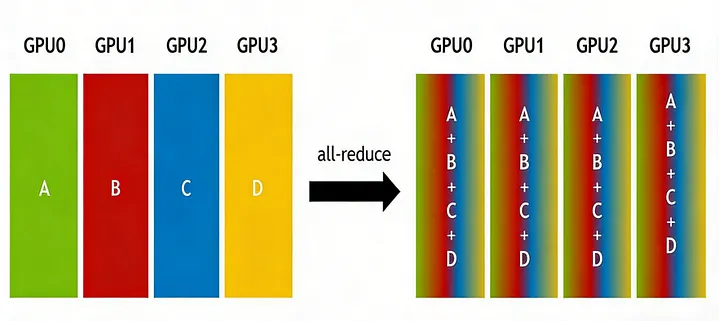
Source: In-Depth Understanding of AI Distributed Training Communication Primitives. The article visualizes all-reduce as a cluster-wide reduction whose reduced output is delivered back to every GPU.
Where All-Reduce Appears in Training
| Parallelism | What gets all-reduced | Frequency |
|---|---|---|
| Data parallelism | Gradients | Once per batch |
| Tensor parallelism | MLP output (after column-parallel linear), attention output (after row-parallel linear) | Every forward + backward pass per layer |
| Pipeline parallelism | None directly (uses P2P send/recv) | — |
Tensor parallelism’s all-reduces are the most expensive because they happen every layer, every forward and backward pass. This is why tensor parallelism is kept within a single node (NVLink): moving those all-reduces across slower inter-node links (InfiniBand) would cripple throughput.
Why Sequence Parallelism Avoids Them
Sequence parallelism has zero all-reduces in MLP blocks. Each device computes its chunk’s MLP independently because the linear layers operate on each token in isolation — no cross-token aggregation is needed. The only communication is ring P2P in the attention block (circulating $K$ and $V$). This is the structural reason sequence parallelism achieves better throughput when composed with pipeline parallelism: it removes the frequent all-reduces that tensor parallelism pays.
Common Confusions
- All-reduce vs. all-gather: All-reduce sums tensors element-wise; all-gather concatenates shards. All-reduce preserves element count; all-gather increases it by $t \times$.
- All-reduce vs. reduce: Reduce sums across ranks but delivers the result to only one rank. All-reduce delivers it to everyone.
- All-reduce vs. reduce-scatter: Reduce-scatter performs the reduction but leaves each rank with only one shard of the reduced result. All-reduce = reduce-scatter followed by all-gather.
Where It Appears
- Megatron-LM: GPU-Cluster Training Parallelism — Tensor parallelism creates frequent all-reduces inside each Transformer layer; keeping them within a DGX node over NVLink is a core design constraint.
- Sequence Parallelism: Splitting Sequences Across GPUs — Sequence parallelism avoids all-reduces in MLP blocks entirely because each chunk’s linear layers operate independently.
- vLLM: PagedAttention Serving Framework — Workers synchronize intermediate results through all-reduce in tensor-parallel inference.
- LLaMA: Open and Efficient Foundation Language Models — LLaMA overlaps all-reduce communication with computation to hide gradient-synchronization latency.
- NVFP4 — Uses all-reduce for distributed amax and scale statistics.
- vLLM Architecture and Code Organization Overview — A top-down code-reading map of the vLLM repository at commit a0c092ee72c0: how the V1 serving engine, model executor, config.
- vLLM-Ascend Architecture: How the Ascend NPU Port Integrates with vLLM — A code-reading tour of how vllm-ascend maps onto vLLM’s six-layer stack and extends upstream vLLM for Ascend NPU execution.
- GPipe: Micro-Batch Pipeline Parallelism — GPipe introduces synchronous micro-batch pipeline parallelism with re-materialization, achieving near-linear speedup when.
- Context Parallelism for Scalable Million-Token Inference — Contrasts CP’s ring KV/Q traffic with tensor parallelism’s frequent all-reduces across model layers.
-
vLLM DCP and PCP: Decode and Prefill Context Parallelism — DCP’s AG+AR merge can replicate merged attention output across PCP/DCP ranks.
- vLLM DCP Attention: From Local LSE to Exact Global Output — Uses all-reduce to replicate the exact merged attention output across ranks in the AG+AR backend.
Related Terms
- All-Gather — The gather counterpart; all-reduce sums, all-gather concatenates.
- Scatter/Gather — Pipeline optimization that avoids redundant cross-node sends; relies on intra-node all-gather.
- Sequence Parallelism — Avoids all-reduces in MLP blocks by splitting along the sequence dimension instead of hidden/head dimensions.